

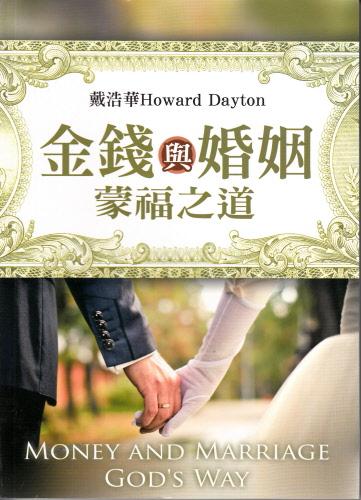
“Money and Marriage—God's Way” by Howard Dayton (Moody Publishers, 2009). The Chinese translation was published by Taiwan Crown, translated by Mei-Fen Ku and Wei-Yun Lin, distributed by Taosheng Publishing House (Taipei), with the Chinese edition released in July 2014. The author is Howard Dayton, co-founder of Crown in the United States. This reader's guide is written by Professor Ying-Gan Wen, director of Crown's North American Chinese Outreach Ministry and honorary professor at National Dong Hwa University, Taiwan.
1. Introduction: The Author's Background and Works
The author, Howard L. Dayton, Jr. (b. 1943), is a co-founder of Crown Financial Ministries in the United States; the other co-founder was the well-known Christian financial expert Larry Burkett (1939-2003). Both wrote several bestselling books applying biblical principles to money, as well as small-group study materials on biblical finance that are widely used around the world.
Dayton grew up in Georgia. After graduating from Cornell University's School of Hotel Administration in 1967, he served two and a half years in the Navy, opened a very successful restaurant in Florida in 1969, and began a commercial real-estate business there in 1972. In 1974 his life began to change dramatically: a business partner suggested he study what the Bible says about money, and they discovered that Scripture contains 2,350 verses about money or finances. He sensed God's call to share these life-changing principles. In 1985 he founded Crown Ministries and developed a biblical financial small-group curriculum; in 2000 it merged with Burkett's ministry to form Crown Financial Ministries, with Burkett as CEO. After Burkett died of cancer in 2003, Dayton served as CEO (both as unpaid volunteers) until retiring in 2007, after which Chuck Bentley took over as CEO to the present day.
During his time at Crown he wrote the Biblical Financial Study small-group handbook, which became popular in North America and was used by Crown branches in about ninety countries; the “Business God's Way” study handbook and audiovisual materials he produced with Burkett were also translated into many languages and used by Christian business people worldwide. Taiwan Crown is one of Crown's branches. In 2009 Dayton and several coworkers left Crown to found Compass—Finances God's Way (compass1.org), focusing on small-group Bible study; by 2014, forty-eight countries were involved in Compass, complementing Crown's work in promoting biblical finance.
Dayton has published six books: Our Money: Frustration or Freedom (1979), Your Money Counts (1997), Free and Clear (2006), Your Money Map (2009), Money and Marriage God's Way (2009), and Business God's Way; he also partnered with the American Bible Society to publish the Financial Stewardship Bible (2011), which highlights the finance-related verses of Scripture and adds a study guide. Your Money Counts has been translated into Chinese by Taiwan Crown and is required reading before joining the Crown Biblical Financial Study small group.
For his outstanding contribution to biblical finance, Dayton received an honorary doctorate from Asbury University in 2008; in March 2014 the university established the Howard Dayton School of Business in his name, a school that emphasizes practice and character education. A friend described Dayton's character as “service and sacrifice, not self and stuff.” Dayton married his wife Beverley in 1971; they have two grown children and live in Orlando, Florida. Understanding the author's background greatly helps in reading this book, for to read a book is in a way to read the person.
2. The Book's Purpose and an Overview of Its Contents
On the first page the author dedicates the book to his wife—“Beverley, my wife, best friend, lifelong companion, and hero.” Clearly their marriage of more than forty years has been happy and secure. The book gives many examples of the challenges he and his wife faced in finances and in their relationship, and how they resolved them, as models for the reader. In the preface the author states the book's purpose: “This book will transform your marriage and your finances... As you begin to learn how the God who rules the universe builds a good marriage and manages money successfully, and as you practice these principles in life, you will be transformed.”
The book is written for engaged couples and any married person, regardless of wealth or marital situation; learning its principles and testimonies and actually practicing them brings results—the only danger is shelving the book, or reading without doing. According to various surveys, the main causes of divorce are finances, communication, and the sexual relationship (including affairs). A large part of financial problems also stems from poor communication and a lack of shared values, so money and marriage are closely intertwined.
The book has six parts, seventeen chapters, and a conclusion. Each part ends with response questions, help resources (online and otherwise), and a couple's financial testimony. Part 1 covers the basic principles of marriage; Part 2 addresses spouses' differing backgrounds and personalities in handling money, and how to communicate, solve financial problems in a balanced way, and build a family culture of encouragement, gratitude, and celebration; Part 3 discusses the practical steps toward financial freedom, using the author's “Money Map” to guide readers in budgeting deliberately and moving step by step toward financial freedom; Part 4 discusses the challenges, problems, and crises couples commonly face on the way to financial freedom, and how to weather them; Part 5 covers finances at different stages of marriage (from engagement to the empty nest); Part 6 addresses whether to be a full-time mother, and the financial issues and solutions for blended families. Every part balances biblical principle with practical steps, well worth careful reading and application.
3. An Overview of Each Part
Part 1: Marriage is a lifelong commitment. The author opens with a couple on the brink of divorce over a financial crisis who seek his help, and proposes “managing family finances God's way.” He summarizes the Bible's view of marriage: marriage is instituted by God, and husband and wife are one flesh (Genesis 2:24; Matthew 19:6), needing unity in body, emotions, spirit, and finances. The marriage relationship takes priority over the relationship with each set of parents; the author quotes a marriage expert: “The root of all marriage problems is a failure to leave or a failure to cleave.” Keeping a marriage healthy requires understanding each spouse's role, on the basis of “mutual submission” (Ephesians 5:21); husband and wife are equal, to love and submit to one another and serve one another in love (Galatians 5:13).
Part 2: Encouragement—why and how. The author “cheers for the differences between spouses”: couples will always differ (gender, background, personality, spiritual life), and “God gave you your spouse to complete you, not to frustrate you.” In handling money they must learn good communication—above all listening to each other and being honest. The author recommends a weekly “money date” to discuss finances and pray together—“when couples pray together over their finances, they learn what matters to their spouse, and they invite the God of the universe to care personally about their income and spending.” Couples should also learn to encourage each other, to “be your spouse's cheerleader,” and to celebrate progress in their finances.
Part 3: Money—the flow of expenses and income. The heart of this part is the Money Map, designed by the author and the Crown team to guide readers toward financial freedom; it has helped millions escape debt, build savings, and invest wisely. The Money Map proceeds in seven destinations: set up a spending plan and begin an emergency fund; pay off credit-card debt; pay off consumer debt; save for major purchases (a home, retirement, children's education); buy a home and begin investing wisely; pay off the mortgage and fully fund education; and finally fully fund retirement, reaching financial freedom to serve God all the more. The author found 2,350 verses about money in Scripture—“every time I apply the Bible's financial truths, I find my relationship with Jesus Christ has grown.” Acknowledging God as the owner of everything, we are merely stewards, to manage faithfully and give generously (at least a tenth of our income). Moreover, debt is a major source of financial stress and conflict in marriage, and the one in debt becomes a slave to the lender (Proverbs 22:7); this part discusses methods of repayment and warns against co-signing for others. Spending habits deeply affect the marriage relationship, so learn contentment, avoid comparison, and faithfully follow a budget.
Part 4: Common problems and conflicts. Every couple faces serious challenges (a child with special needs, job loss, illness or accident, adult children still at home, foreclosure or bankruptcy). When a challenge comes, the first step is communication, regular sharing, and prayer—“the stronger the marriage and the healthier the finances, the better you can face problems.” The factors that most often cause conflict tend to involve money; conflict is resolved by showing love and goodwill to one another and by mutual forgiveness. The fuller a spouse's “trust account,” the more your love is felt and the easier conflict becomes to handle. The author suggests writing down mutually agreed ground rules for communication before a conflict erupts. In a crisis, first recognize its seriousness, pray and agree on principles for handling it, and seek different levels of counsel according to the severity.
Part 5: Seasons of life—from engagement to the empty nest. Before marriage, every engaged couple should do four things: fully disclose their finances; discuss their financial goals, values, and expectations; build a spending plan together; and learn to handle money God's way—the author advises against marrying until these four are done. Watch the cost of the wedding, do not go into debt to be extravagant, and handle in-law relationships by biblical principle. Drawing on his own marriage of more than forty years, the author describes three stages—newlywed, full nest, and empty nest—each facing financial issues of lifestyle, buying versus renting, and wills and estate planning.
Part 6: Building your own sweet home. Should the wife be a full-time mother? The author suggests first calculating the real impact on family finances of losing her income: after taxes, commuting, childcare, and extra clothing costs, her net income from working outside may not be high; if she can take on some work from home, the net may be higher. It is best for a couple to agree before and after marriage, praying together to seek God's will, and there is no need to feel guilty if she must work outside. As for remarriage (blended) families, marriage, finances, and parenting are all more complex; the most important thing is communication, with encouragement to be as financially united as possible and to agree on raising the children. In the conclusion, the author hopes the book will not sit on a shelf but be studied and practiced together as a couple; one of the best ways to apply what you learn is to teach others.
4. The Book's Usefulness and Limitations
Usefulness: The book not only teaches Bible-based financial principles and methods, but through financial health strengthens the marriage relationship and draws the couple closer to the Lord. Since one of the main causes of divorce is money problems and the next is communication, the book gives practical, well-grounded teaching on both. The author stresses beginning to manage money before marriage; yet even for those long married, the book has reference and practical value—it is never too late to begin. Even in the empty-nest stage, its principles can be taught to the next generation. This reviewer highly recommends that engaged and married Christian couples invest time to study the book together. Moreover, many principles in Chapter 17 on blended families also serve single-parent families well. Readers who have taken the Crown Biblical Financial Study small group will find the book easier, since many principles (including the Money Map) are covered there; and because this book emphasizes the marriage relationship, it complements the small-group study.
Limitations: Because this book (and other Crown publications) was originally written for American readers, non-American readers must adapt the U.S. examples (such as retirement funds, college education funds, and estate planning). Also, because the U.S. Crown Financial Ministries website (crown.org) was substantially redesigned after Dayton left, several sites mentioned in the book no longer exist; the translators have added notes and located similar pages (such as the author's new ministry Compass at compass1.org) for reference. Readers in Taiwan or other regions should consult their local Crown website (for example, Taiwan's crown.org.tw).